Complete Guide to French Motorways & Highways
Navigate France's autoroute network with confidence - tolls, routes, and expert driving advice for 2026
Understanding the French Motorway System
France boasts one of Europe's most extensive and well-maintained motorway networks, known locally as "autoroutes." These highways connect major cities and regions while providing efficient routes for both domestic and international travel. Understanding the French motorway system is essential for anyone planning to drive through France, whether for tourism, business, or transit to other European destinations.
The French motorway network spans over 11,800 kilometers, making it the fourth-largest highway system in the world. Most of these routes are toll roads (péage), operated by private companies under government concession. The toll system helps maintain high-quality road surfaces, comprehensive service facilities, and excellent safety standards throughout the network.
This comprehensive guide covers everything international drivers need to know about French motorways, from toll calculation and payment methods to traffic patterns and route planning strategies.
French Motorway Toll Gate Guide
Principal Signs on French Motorway Toll Gates

Three tollgates on a French motorway:
Left
Only for vehicles with the drive-through remote payment transponder (télépéage)
Speed limit: 30 km/hr
Center
For vehicles with the télépéage transponder OR pay by credit card
Right
All forms of payment - cards and cash
Other Toll Gate Signs
Accommodation in Rural France
French gite and B&B locator maps
Book directly in English with the owners
Gitelink.com
Many toll-gates are for both card payment (credit card or debit card) and Telepéage, meaning that if you have a télépéage transponder, you may still get held up behind people paying by card if there is a queue.
Cash payment toll-gates (green arrow or pictogram of coins) will provide change – even the automatic ones.
For occasional French motorway users, subscribing to the Liber-T system is generally not cost-effective - unless you think that 20€ a year is worth paying to save perhaps a total of 10 minutes at the tolls, or are only travelling during very busy periods. On normal days, you can be through a payment booth in a minute or less, especially with a contactless credit card.
Note: The "Liber-T" charging sensor is available in the UK, but Sanef, the French motorway operators' company, charges higher rates for users applying via its English language website than for applications from its French website - which can only be used by people having a bank account in France.
Motorway Toll Calculator
Calculate tolls for popular French motorway routes instantly
Route Information
Note: Toll rates are updated annually each February. Prices shown are for 2026 and may vary slightly depending on specific entry and exit points.
Major French Motorways (Autoroutes)
A1
Autoroute du Nord
Route: Paris - Lille
Major route connecting Paris to northern France and Belgium
Key Features:
- Heavy traffic
- Important commercial route
- Multiple service areas
A6
Autoroute du Soleil
Route: Paris - Lyon
The famous 'Highway of the Sun' leading south from Paris
Key Features:
- Scenic route
- Heavy summer traffic
- Gateway to southern France
A7
Autoroute du Soleil
Route: Lyon - Marseille
Continuation of the A6, following the Rhône Valley
Key Features:
- Mediterranean access
- Mountain views
- Busy holiday route
A10
L'Aquitaine
Route: Paris - Bordeaux
Main route to southwestern France and Spain
Key Features:
- Atlantic coast access
- Wine regions
- Spanish border route
A4
Autoroute de l'Est
Route: Paris - Metz
Eastern route connecting Paris to Germany and Luxembourg
Key Features:
- International traffic
- Business corridor
- Champagne region
Free Motorways and Alternative Routes
Save Money with Toll-Free Routes
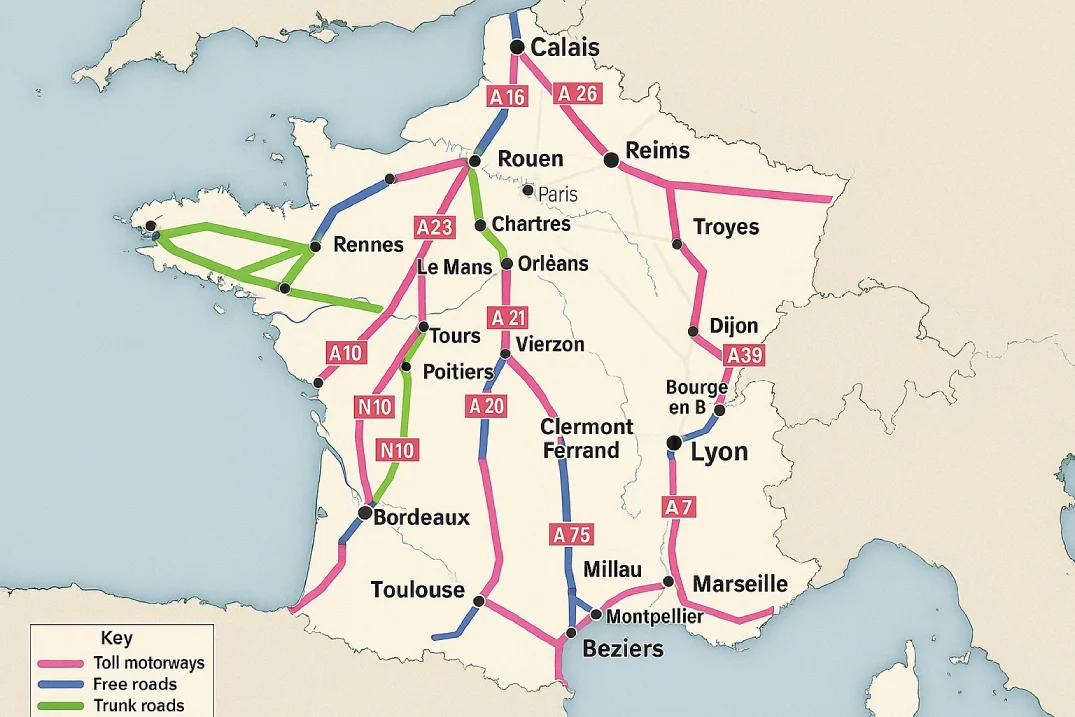
While most French motorways charge tolls, several significant routes remain free. These alternatives can save you money while still providing high-quality driving conditions.
A16/A28
Calais - Rouen
Two-thirds of the route is toll-free
A84
Caen - Rennes
Completely free motorway in Normandy/Brittany
A20
Vierzon - Brive
275 km of free motorway, longest free section in France
A75
Clermont-Ferrand - Béziers
340 km free route to Mediterranean (except Millau Bridge)
Urban Motorways
Various cities
Most urban and suburban motorways are toll-free
Money-Saving Tips
- • Use the A20 from Vierzon to Brive for a completely free 275km stretch when traveling to southwest France
- • The A75 provides a scenic toll-free route to the Mediterranean, avoiding busy coastal motorways
- • Urban motorways around major cities are typically free, making city approaches more economical
Traffic Patterns and Travel Planning
When to Travel and When to Avoid
Summer Saturdays
AvoidHeavy holiday traffic, especially July-August
Affected routes: A6, A7, A9, A10 particularly affected
Winter Weekends
CautionSki traffic to Alpine regions
Affected routes: Alpine motorways (A40, A43, A41)
Easter/May Holidays
BusySpring holiday traffic
Affected routes: All major routes southbound
Regular Weekends
GoodHGV restrictions make driving easier
Affected routes: All routes benefit from truck bans
Peak Traffic Periods to Avoid
Summer 2026
Black Saturdays: July 12, 19, 26
Heavy traffic every Friday-Saturday from July 1 - August 12
Return Traffic
Worst weekends: August 9, 16, 23
Heavy northbound traffic all August weekends
Holiday Periods
Easter: April 18-21
May holidays: May 1-4
Whitsun: June 6-9
Toll Payment Methods and New Free-Flow System
New: Free-Flow Tolling
France is introducing free-flow tolling on select motorways, eliminating toll booths. The A13 (Paris-Normandy) and A79 (Central France) now use automatic license plate recognition.
Traditional Toll Booths
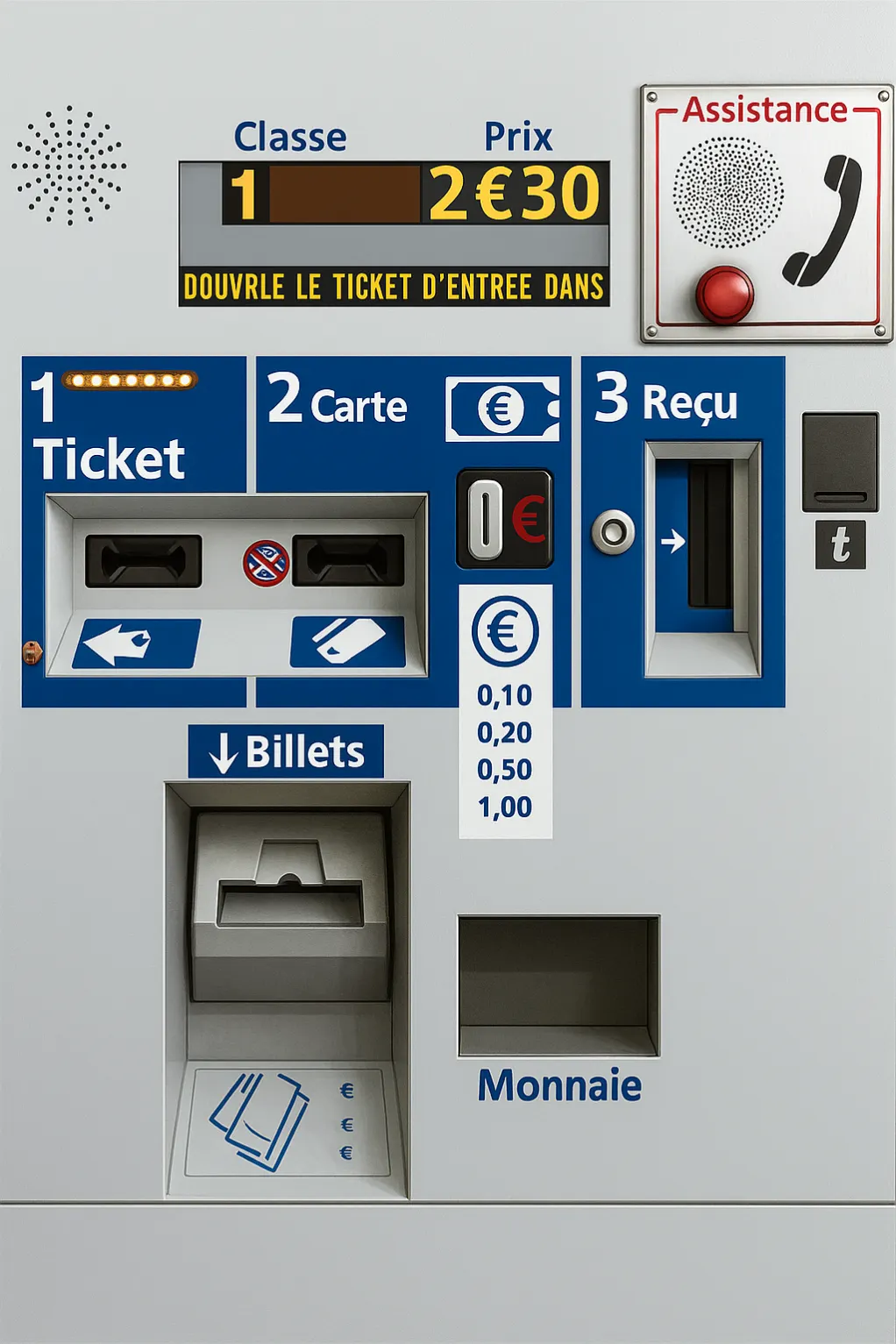
An automatic toll machine on a Vinci motorway. The "Ticket" slot is for your toll ticket. "Carte" refers to your credit/debit card. This particular machine doesn't have the RFID/NFC contactless payment symbol yet, so you can't simply tap your card or smartphone. Notice the flag buttons on the left that provide instructions in French, English, or Spanish.
Insert your toll ticket into slot #1 (marked "Ticket"). The toll amount will display on the "Prix" digital screen above (for example: 2 euros 30 centimes, as shown in the image).
Insert your French credit card into slot #2 (marked "Carte"), or tap your RFID/NFC-enabled card or smartphone on the corresponding symbol (if available); alternatively, insert euro coins (10-, 20-, and 50-cent, 1- and 2-euro coins) into the slot marked "Pièces" and/or euro banknotes (5, 10, 20, and 50 euros) into the slot marked "Billets".
If you overpay, change will be returned through the "Monnaie" opening.
Once the full toll amount has been processed, the barrier gate will automatically rise.
Press the "Reçu" button to get a receipt (if desired). Then proceed through the toll gate.
Something's not working? Hit the "Assistance" button (you'll find it in the top right corner) and someone will come help you out.
Whatever you do, don't reverse! Stay put and wait for help.
Credit/Debit Cards
Visa and Mastercard widely accepted. Contactless payments available.
Cash Payments
Euro notes and coins accepted at manned booths and some automatic lanes.
Télépéage (Electronic Tag)
Automatic payment system for frequent users. Subscription required.
Free-Flow Payment
How It Works
Cameras automatically read your license plate as you pass through designated zones. No stopping required.
Payment Options
- • Online within 72 hours (SANEF or Aliaé websites)
- • At payment kiosks near motorway entrances
- • At affiliated tobacco shops and newsagents (Nirio network)
Important
Failure to pay within 72 hours results in fines. Always note your journey details.
Essential Driving Tips for French Motorways
Speed Limits and Safety
Standard Speed Limits
- • Motorways (dry conditions): 130 km/h (80 mph)
- • Motorways (wet conditions): 110 km/h (68 mph)
- • Dual carriageways: 110 km/h (68 mph)
- • Urban areas: 50 km/h (31 mph)
- • New drivers (first 3 years): Reduced limits apply
Speed Camera Network
France has extensive fixed and mobile speed camera coverage. Fines for speeding are substantial and can be issued to foreign registered vehicles.
Fuel and Services
Fuel Costs (2026)
- • Unleaded 95 (E5): €1.75/liter
- • Unleaded 98 (E5): €1.47/liter
- • Diesel (B7): €1.70/liter
- • E85 Biofuel: €1.75/liter
- • EV Fast Charging: ~€0.55/kWh
Money-Saving Tip
Exit motorways near hypermarkets for cheaper fuel - savings up to 15 cents per liter compared to motorway service stations.
Required Equipment for Foreign Drivers
Mandatory Items
- • Valid driving license (EU/UK) or International Driving Permit
- • Vehicle registration documents
- • Valid insurance certificate
- • Headlight deflectors (for UK/Irish vehicles)
- • GB/UK stickers (post-Brexit requirement)
Recommended Items
- • High-visibility vests (one per occupant)
- • Warning triangle
- • First aid kit
- • Spare bulbs
- • Emergency phone numbers
Motorway Service Areas and Overnight Stops
Types of Service Facilities
Aires de Repos (Rest Areas)
Basic facilities every 10-15 km
- • Parking areas
- • Picnic tables
- • Toilets
- • Information displays
Aires de Service (Service Areas)
Full facilities every 40-60 km
- • Fuel stations
- • Restaurants and cafes
- • Shop facilities
- • ATMs and phone booths
- • Children's play areas
Hotel Areas
Overnight accommodation
- • Chain hotels (Ibis, Campanile)
- • Restaurants
- • Conference facilities
- • Easy motorway access
Popular Hotel Chains Near Motorways
Budget
F1, Ibis Budget
€40-60/night
Mid-Range
Ibis, Campanile
€60-90/night
Comfort
Mercure, Novotel
€90-150/night
Premium
Pullman, MGallery
€150+/night
Strategic Route Planning
Avoiding Paris: Alternative Routes
Why Avoid Paris?
Paris ring roads (Périphérique) are consistently congested, especially during rush hours and holiday periods. Alternative routes often save time and stress.
Route 1: Calais to Southern France via Reims
Take A26 → A5 → A6 (avoiding Paris completely)
- • Completely bypasses Paris traffic
- • Scenic route through Champagne region
- • Generally less congested
Calais-Marseille: 1,060 km
Additional cost: ~€5 in tolls
Route 2: Western Route to Southwest France
Rouen → Chartres → Orléans → Tours (partial motorway, some toll-free sections)
- • Lower toll costs
- • Less truck traffic
- • Historic towns en route
Destinations in Loire Valley, Poitou-Charentes, and Bordeaux region
Peak Traffic Bottlenecks to Avoid
Chronic Congestion Points
- • A6/A7 through Lyon (Tunnel de Fourvière)
- • A7 Rhône Valley (Orange to Aix-en-Provence)
- • A10 around Bordeaux
- • A1 approaching Paris from north
- • A86/N86 Paris outer ring road
Seasonal Hotspots
- • A8/A57 Nice-Marseille (summer)
- • A9 towards Spanish border (July-August)
- • A40/A43 Alpine routes (winter ski season)
- • A63 around Biarritz (summer)
- • All coastal approaches (holiday weekends)
Guide for International Drivers
Documentation Requirements
EU/EEA/UK Citizens
Your national driving license is valid for tourist visits up to 12 months. No additional permits required for tourist travel.
US/Canadian Drivers
National license is generally accepted, but an International Driving Permit (IDP) is highly recommended for insurance purposes.
Other Countries
Valid national license PLUS either official French translation or International Driving Permit required.
Insurance and Liability
Minimum Requirements
- • Third-party liability insurance (mandatory)
- • Proof of insurance certificate in vehicle
- • Insurance must be valid in France
Recommended Coverage
- • Comprehensive coverage
- • European breakdown assistance
- • Legal expenses insurance
- • Personal accident coverage
Important Legal Differences
Priority Rules
- • Priority to the right at unmarked junctions
- • Roundabouts: priority to traffic already on roundabout
- • Trams have absolute priority
Zero Tolerance Policies
- • Mobile phone use while driving
- • Radar detector devices (illegal to possess)
- • Alcohol limit: 0.05% (lower than UK/US)
Environmental Initiatives and Future Developments
Environmental Progress
France has made significant environmental improvements to its motorway network, including the elimination of Low Emission Zones (ZFEs) in 2026 following substantial air quality improvements.
Electric Vehicle Infrastructure
Current Coverage
- • Fast charging stations at virtually all service areas
- • Multiple charging operators (Ionity, TotalEnergies, etc.)
- • Charging speeds up to 350kW available
- • Urban charging networks expanding rapidly
Pricing Structure
Average motorway charging costs around €0.55/kWh. Subscription plans and off-peak rates available from major operators.
Future Developments
Free-Flow Expansion
The free-flow tolling system will expand to more motorways:
- • A40 towards Geneva (next planned conversion)
- • Gradual rollout across entire network
- • Complete elimination of toll booths by 2030
Smart Highway Technology
- • Dynamic traffic management systems
- • Real-time congestion monitoring
- • Enhanced weather warning systems
- • Integration with GPS navigation apps
Emergency Procedures and Safety
Emergency Contact Numbers
Motorway Emergency Phones
Orange emergency phones every 2km connect directly to motorway control centers. Use these for breakdowns and non-life-threatening emergencies.
Accident Procedures
Immediate Actions
- 1. Secure the scene - hazard lights, warning triangle
- 2. Move to safety behind barriers if possible
- 3. Call emergency services (112 or motorway phone)
- 4. Exchange insurance information
- 5. Document damage with photos
Required Documentation
- • Driver's license
- • Vehicle registration
- • Insurance certificate
- • European Accident Statement (if available)
Plan Your French Motorway Journey
Key Takeaways
- • French motorways offer excellent road quality but require toll payments on most routes
- • Free-flow tolling is expanding - always check payment requirements
- • Avoid summer Saturdays and plan alternative routes around Paris
- • Service areas provide comprehensive facilities for long-distance travel
Additional Resources
Official Motorway Information
Visit ASFA (French Motorway Companies Association) for real-time traffic and toll updates
Route Planning Tools
Use ViaMichelin or similar services for detailed journey planning with current toll costs
Traffic Information
Bison Futé provides official French government traffic forecasts and alternative routes
Last Updated: 2026 | Information Accuracy: Toll rates and regulations current as of 2026